Upcoming Presentation on Customer Support via Social Media for B2B Companies
Posted: October 17, 2014 Filed under: Uncategorized Leave a commentJust a quick (and late) note that I’m going to be presenting in 5 days in Las Vegas on the topic above. TSIA invited me to present on this topic at their Technology Services World 2014 conference. I presented at this conference on a very similar topic last year, but that was admittedly a very B2C focus. TSIA members are 95% B2B, so there is a lot of interest in focusing on those use cases.
If you’re interested in attending, my main focus will be to deliver on the following:
- Social Media is important for customer support
- B2B; not just B2C
- Arm the Support leaders with what they need to go back internally to talk with the marketing team and have a productive conversation
- What Avaya can do for companies in this space.
If you are attending the conference, I’ll be in Bristlecone 4 from 11:30am-12:30pm on Wednesday, October 22nd.
I hope to see many of you there!
Carl

Why Social Media is the New Customer Service Channel
Posted: October 10, 2013 Filed under: Uncategorized | Tags: Avaya, Customer Service, customer support, Facebook, google plus, linkedin, media, nfl, social, social media, support, Twitter Leave a commentThis is a combination of three separate posts on this topic (First, Second, & Third)
When the NFL planned its operations for Super Bowl 2012, social media was front and center. They built a huge social media control center, including 150 ft2 of networked screens, where fifty experts logged 15-hour days for two full weeks. They monitored social media networks, racking up 64 million mentions, and impressively responding to most of them in just minutes. The NFL estimates that the effort earned $3.2 million in positive press and a 12.5% boost in consumer sentiment (source).

NFL’s Super Bowl Social Media Command Center (source)
Widespread adoption of social media has forced companies to manage their brand in an entirely new way. As consumers have an ever-growing sounding board for their dissatisfaction with a brand, proactively promoting and managing a brand is no longer enough on social media; the brand must now treat social media as another customer service channel and manage it as such. Doing so allows for quick and effective response to negative brand impressions. Not only does this minimize damage, but it can also turn brand detractors into promoters.
While most would agree that satisfying your customers is crucial to a company’s success, the magnitude of unresolved customer service needs to be understood: 17% of customers will leave a brand after a single incident, 40% more will leave after a second incident, and 28% more after a third mistake. Combine those and 85% of a brand’s customers will switch to a competitor after only 3 mistakes.

Bad service leads to poor loyalty, which negatively impacts sales. More than 80% of surveyed consumers say they have abandoned a purchase because of a poor service experience (source).
Despite a company’s best efforts, poor service experience is inevitable, but how the company responds can make all the difference. Service recovery is a key skill for the company and begins with first being aware of the customer’s dissatisfaction. Once aware, the company must have empowered employee(s) who can work with the customer to ask questions, get to the heart of the matter, and be in a position to resolve the matter. One new way to deliver this customer service is through the monitoring of social media.
Odds are that if you’ve made your way to this blog, you are already familiar with social media, but let’s do a level set. Social media refers to technologies that allow for people and companies to share text, images, audio, and video content with other users. It primarily consists of social networks (such asFacebook, Twitter, Google+, and LinkedIn) as well as others. Social media also includes online communities such as discussion boards and forums where people come together to publically discuss topics of interest, which can be indexed by online search engines such as Google or Bing, enabling other users to find relevant conversations.
When it comes to which social media networks companies choose to leverage, of the Fortune 500 companies, 73% have active Twitter accounts and 66% have active Facebook pages. The use of blogs remains relatively low at only 28% (source). To put the scale in scope, the table below shows the number of followers and fans for some of the biggest brands. It is important to note that many of these brands have multiple Twitter and Facebook pages, but the table only shows their primary accounts (thus their total influence is even greater).

The consumer’s power to shape a company’s brand continues to increase as social networks grow. This is due to the network effect, which describes how the value of a service increases as the number of people using that service increases. This concept is best captured by Metcalfe’s law, developed by Bob Metcalf in the 1980s, which explains that despite the linear cost to deploy a local area network (LAN), the value realized by the users is exponential (source: Hendler, J., & Golbeck, J. (2007). Metcalfe’s law, Web 2.0, and the Semantic Web. Journal of Web Semantics , 6.). This law has been found applicable to the growth of telephones, mobile phones, faxes, email, video conferencing, and most recently, social media networks such as Twitter and Facebook. In short, the more people who have access to the same technology as you, the more value you will receive from that technology.
While the value of utilizing social media channels can be hard to calculate, a report from McKinsey Global shows that 4,200 companies stand to see a sum of $900 billion to $13 trillion of value unlocked (source). The report continues that two-thirds of the estimated value comes from “improved communications and collaboration within and across enterprises.” This estimate is large enough to justify companies engaging in social media even without direct business cases. There is extensive literature on how best to manage social media return on investment, but I won’t be covering that here.
In a 2011 study by DMG Consulting of 132 operations, two-thirds were already utilizing social media channels for at least one form of interaction (source). Of the respondents, 76% used it for marketing as it allows for both deeper and broader engagement with the brand than any other medium. Marketers utilize social media for advertising as well as listening to their customers. When properly leveraged, these channels can help get the brand message to the customer as well as encourage buzz which further helps to spread the message.


In fact, research shows that 90% of consumers trust their friends’ recommendations for product over brand loyalty (source: Shahim, B. (2011, April/May). How Social Media has Shared the way Brands Speak to Consumers. Journal of Marketing). Thus, branding pushed by the marketing department has less and less impact as consumers are more and more able to easily share their opinions with one another. Consumers see value in social media, and thus the brand needs to participate and influence those networked conversations.
On November 28th David Allen, the author of Getting Things Done, had a poor experience withAdobe support. After not receiving satisfactory service, he tweeted to his 1.2 million followers about his poor experience 7 times, eventually questioning the overall brand of Adobe. Within a day, he heard back from Adobe and his issue was resolved, but for 24 hours, 1.2 million people heard a trusted person badmouth Adobe. Not a good day for the brand.
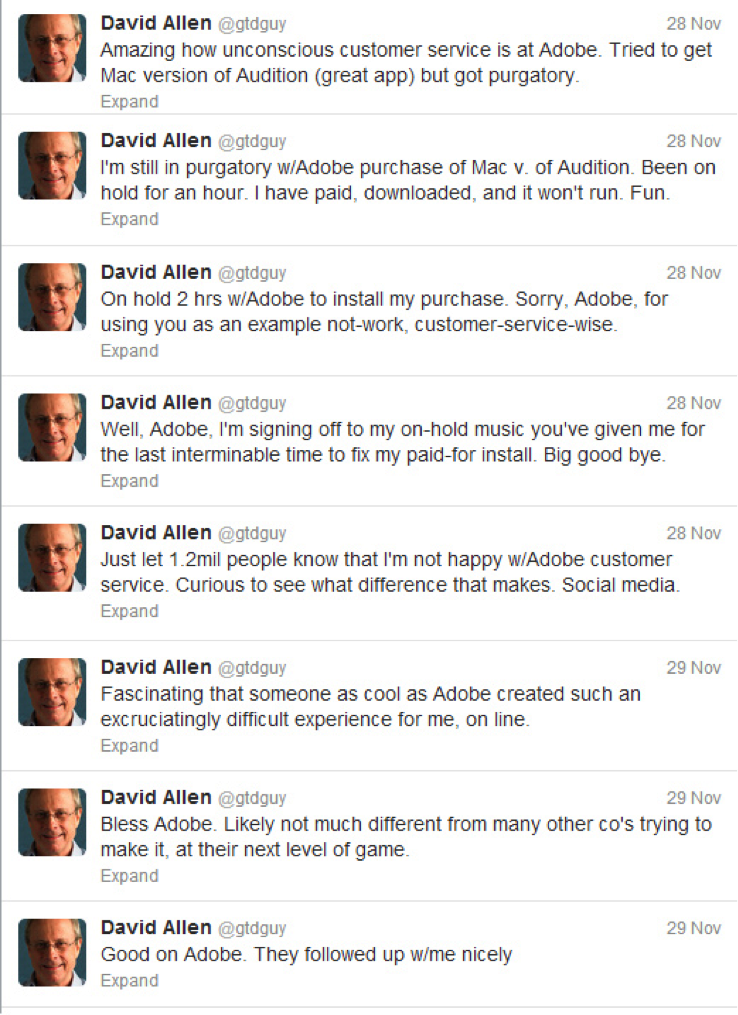
As David’s example above shows, social media networks are enabling customers to act bigger, engage faster, and be better organized. For decades, consumers have run into problems with purchased products or services from companies. In the past, complaining to a company took some time and thought. First there was complaining in person, then by letter, and with the option of the telephone, these complaints turned to call centers. As the Internet grew in popularity, call centers became contact centers with the addition of e-mail and chat channels of communication. As new forms of communication are developed and adopted, consumers use them to complain to companies. Customers want to engage with brands on their terms; their channels. They do not think in terms of discreet channels when interacting with companies. They make no delineation between contacting the company via phone, email, chat, or social. They likely do not even differentiate between sales, support, or marketing; they simply see the larger brand.
People prefer sharing their frustration with the online network rather than going directly to a company. They may believe that the company is more likely to respond to a complaint once it is in the public domain, and if so, those companies need to consider this as a failure of their non-social-media support channels. The network effect increases the downside of getting service wrong and the upside of getting it right. When service is delivered well, social media users will herald it; and when the service is poor, they will do the same. Additionally, companies need to understand that social media is much more than just a marketing vehicle. Of the actionable tweets and posts a company receives, 80% are related to service, with only 20% being about marketing (source). While sales and marketing have been the promise of social media, service is the actual delivery.
According to Gartner Inc., by 2014, organizations that ignore their customers on social media will have the same negative perceptions companies experience today when they ignore customer’s minimal expectations of support via email and phone. In fact, not only are 25% of customers likely to share a postivie experience, but 65% will share a negative one (source). Furthermore, responding to questions about products through social media will become table stakes for marketing departments. According to Carole Rozwell of Gartner, the failure of a company to respond to a social media user can lead to a 15% increase in the brand’s churn rate (source). This gives further evidence that companies must put a social media monitoring program in place or risk financial losses.
While social networks may not be as real-time as a voice call, users do expect a relatively quick response. Laura Bassett, Marketing Director at Avaya says that “Twitter users expect a response within 5 minutes when complaining about a brand”. While most companies won’t be able to manage a response time like that, they are aware of the need to be timely. In a recent study where researchers tested response times, Zappos proved the speediest, posting an average response time of 54 minutes. The next closest companies were Best Buy (1:47), Overstock (1:53), Dell.com (2:28), and L.L. Bean (3:55) (source). Zappos’ quality of service provides them so much positive word-of-mouth buzz that they spend significantly less on marketing than their rival retailers. This is a good example of how an investment made in the customer service department can deliver significant value for the marketing department.
Many individuals, mostly celebrities, have put this network effect into action, with the number one Twitter account, belonging to performing artist Lady Gaga (3.5 million followers.) In fact, 84 of the top 100 Twitter accounts belong to individual people (source). What these individuals say about a company in social media can have a greater impact on the brand than what the company says about itself. A single negative comment on a product or service by one of these influencers can result in significant impact to the brand. The earlier example of David Allen shows this as does an incident that my favorite movie director, Kevin Smith, had with Southwest Airlines.
Mr. Smith had a problem with Southwest Airlines in February of 2010, he took to his Twitter account and its 1.6 million followers at the time (see image of all 20 tweets here). Within sixteen minutes, Southwest had replied, and while that speed helped, the public relation crisis had already begun. Most of the back and forth was over within two days, but it was picked up by national press as well as a strong following in social media (including over 15,000 tweets). Kevin himself tweeted eleven times, each going to his 1.6 million followers and then being retweeted many more times.

After 5 days, the crisis was completely over. Southwest’s brand took a hit as two-thirds of the comments on Twitter were negative towards Southwest.

An interesting comparison is a more recent tweet from Kevin about his flight experience on Virgin Atlantic Airways, which was much more positive as he was seated next to the company’s owner, Sir Richard Branson.

Given this, it is surprising that over half of consumer-facing Fortune 500 companies are not keeping up with their customers desire to use social media. They do not provide links to their Twitter or Facebook accounts on their website “Contact Us” pages. Half of these stragglers do not mention their social media presence on their website at all (source). Not only does this prevent many of the brand’s consumers from interacting the way many want to, but it also portrays the brand as being behind the times, something that can be quite harmful for brands targeting younger demographics. In fact, 15% of 16-24 year old customers prefer social media over any other channel for customer service (source).
USAA, a bank primarily servicing members of the US Armed Forces and their families, is known for delivering the highest levels of customer support, earning them many awards (source). In 2009, USAA started monitoring customer messages on social media sites: “As you’re listening, you don’t want to be a stalker and observer on the web — you want to be jumping into those conversations, particularly as it pertains to reputation management or improving the customer experience,” USAA’s VP of Member Communications, Rhonda Crawford said. Even with USAA’s reputation for customer service, members still take to social media channels as a last resort. “It’s a complaint that comes through a megaphone,” Crawford observed. “When people are tweeting every half hour about a problem they had at the call center, you want to jump on that quickly and resolve the situation.” Crawford also explained USAA’s policy to take social media conversations to a different medium when private details like a customer’s member number are required.
USAA is not the only bank that takes supporting their customers and brand through social media seriously. Citibank ran into a brand problem that started on their blog and migrated to Twitter. While the bank responded to the event in 36 hours, timely for a bank, it wasn’t timely enough for this channel. “The crisis was done in three hours,” Citibank’s Director, Digital Channel Strategy & Social Media, Jaime Punishill said. “In three hours, we had lost the war… Make sure that you prepare for the worst, because it will happen, and it will happen fast..” (source: Crosman, P. (2010, July). Social Butterflies. Bank Systems & Technology, pp. 33-34)
There is encouraging news that companies see the need to move into social media as a customer support channel. In fact, 80% of companies were planning on utilizing social media as part of their customer service strategy by the end of 2012; something they know is important as 62% of their customers are already there (source). While companies are moving to this space, that does not mean they know how to approach the problem. Here are my recommendations on how to proceed.
1. Go with Speed
In most sports, the faster an athlete executes plays, the better the results. The same applies to monitoring for issues online. If an employee can quickly address a problem, they can prevent the complaint from becoming a public relations disaster. Rather than waiting to build the brand’s overall comprehensive social media strategy, the contact center team should create a Twitter handle and target a few of their contact center agents to handle contacts, preferably those that are already engaged in social media themselves. If no such agents are available, consider targeting tech-savvy agents, most likely from a younger demographic, who will be able to quickly grasp social media concepts. An escalation plan is also important, as customers can be unpredictable, in particular after a poor experience. Agents should not be afraid to pull in more experienced personnel to assist.
However, one caveat to “going with speed” is being prepared. Bradley Leimer of Mechanics Bank stresses banks should not set up a presence on a social media site unless they are equipped to deal with customer expectations in that medium. “Once you’re on a platform, you’ve got to be ready to go (source: Crosman, P. (2010, July). Social Butterflies. Bank Systems & Technology , pp. 33-34.).” A study by A.T. Kearney found that in 2011, 56% of the top fifty brands didn’t respond to a single comment on their Facebook pages. On Twitter, brands ignored 71% of customer complaints (source).
2. Engage a Social Media Manager
Simply being a user of social media does not qualify someone to manage a company’s social media program any more than a driver of a car is qualified to lead the release of a new car platform. A proven Social Media Manager will have a track record of not only creating professional Facebook pages, but also coordinating engaging programs that increase the number of online followers, turning many of those followers into champions of the brand. This role not only coordinates social media activities between the marketing and support departments, but also provides guidance and process to teams on how best to perform their function in the new channels. While Facebook and Twitter are the clear heavy-hitters of the industry, an experienced professional will know which other channels to pursue depending on market requirements (LinkedIn, Google+, Pintrest, YouTube, blogging, etc.). With this broad knowledge base, a Social Media Manager can develop a strategy for how to manage the overall brand(s) of the company in this new marketing channel.
3. Collaborate on a Social Media Strategy
While past customer service interactions were mostly one-to-one, actions on social media are all public, thus handling a complaint is not just customer service, but also branding/marketing. As such, the marketing, social media, and customer service teams all need to collaborate on the company strategy
A comprehensive strategy should start with the company’s purpose for using social media: a mission statement that serves as the commander’s intent for all involved in social media on behalf of the company. Whenever an employee or hired agent acts on behalf of the brand, they should understand not only the tactical purpose of their efforts, but also the company strategy. While understanding that a blog post can convey needed information, understanding the larger intent is vital. For instance, a goal that their blog should drive traffic to the website from users who would not typically interact with the brand, would guide the author to include keywords and links to mentioned topics, thus increasing the odds that the blog post will be picked up by as many people as possible.
The social media strategy would outline what sites to be used, which tools will manage content and how analytics will be collected, reported, and then actioned. A good strategy is based on researching which networks customers use and find the best match to reach the customers effectively.
4. Selectively Respond
It is important to evaluate the context of a brand mention and decide if it warrants a response. A one off complaint about the temperature in a company’s retail store does not deserve a response. However, a negative review of the company by an analyst or a legitimate complaint from a customer should be addressed as quickly as possible and within the same channel (Twitter, Facebook, etc.). “Generally the best practice is to acknowledge the issue on social media, but to move attempts to resolve the issue offline,” said Gartner’s Carol Rozwell (source). Determining the right hours of operation is important as well. A small Mom-and-Pop-Shop may only need to staff their presence during normal business hours, but larger companies like an airline, need to staff their social media desk 24×7 because social media users expect real-time response rates.
If the group handling “mentions” on social media cannot handle all relevant comments in a timely first-come-first-serve fashion, then they should consider prioritizing them.
5. Prioritize Responses
Given the cost to the business of customer churn, one approach to prioritizing is to determine if the user is an existing customer and focus on her. Another approach is to use the person’s social influence to determine whom to respond to first. One such rating service is Klout which measures a user’s network reach and their ability to leverage it on platforms such as Twitter, Facebook, Pintrest, WordPress, and many more. Many social media tools, such as HootSuite, enable the employee to see a user’s Klout score as part of the tweet and filter and sort tweets using this as criteria.
Such an approach would have helped when Jayne Gorman, a travel writer who was struggling with a British Airways online reservation. She was unable to reach the company via telephone, so she reached out to them on Twitter.
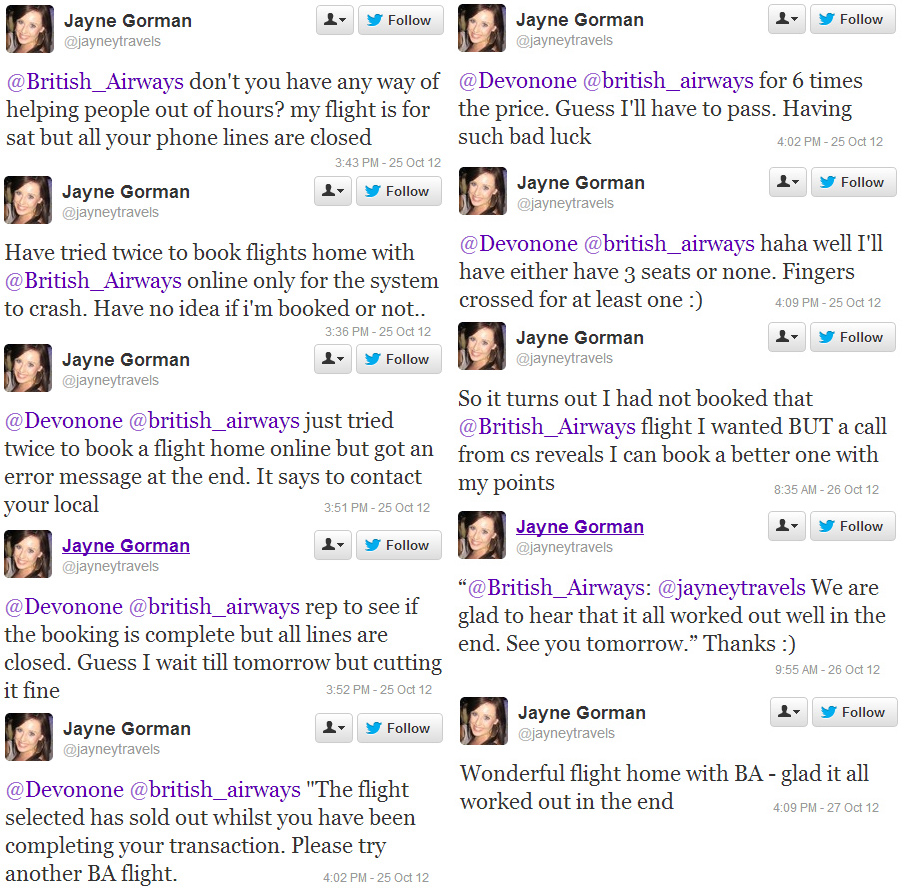
BA could have done a better job at identifying Jayne early on as an online influencer. With over 5,000 followers on Twitter and a Klout score of 63, they should have prioritized the handling of her tweet. Instead, BA took thirteen hours to respond, leading Jayne to write an article on the experience for The Huffington Post. You don’t need to necessarily resolve an issue the way the customer wants it resolved, but what you cannot do is ignore them.
6. Integration with CRM and the Contact Center
The days of treating social media independently from a company’s operations are gone. It needs to be integrated into most, if not all business functions. Some organizations just getting started in social media have implemented the first stages of a social media engagement process, only to make the mistake of treating engagements as ad hoc. These interactions can be much more effective if you are able to match the online user to a customer in your customer relationship management (CRM) tool.
In the previously mentioned DMG study, while 63% of respondents were using social media to provide customer support, only 37% were using a contact center approach. The consequence of not integrating social media with a contact center means that the company experiences missed gains in productivity and customer satisfaction. Without contact-center functionality, the team responsible for monitoring and responding to social media will need to have the skills necessary for supporting customers. Contact center applications provide a work assignment engine, making sure each item is assigned to one and only one employee, helping to determine average response times. “It’s important not only to keep records of individual conversations, but constantly to analyze the interactions to see what insights can be gleaned from them,” said Gartner’s Ms. Rozwell (source).
What tools to use will vary depending on what CRM and contact center tools may already be deployed in the enterprise and the size of the brand. As companies get started, especially smaller organizations, the default Twitter interface may be a starting point, but users will quickly need at least a product like Hootsuite to provide more control. While more than half of monitored brands still use these off-the-shelf tools (source), they provide limited ownership and reporting.
Avaya’s Social Media Manager is an example of suite that provides more advanced tools. It acts as an analytical funnel for all the potential mentions of a brand online and then feeds the actionable items to contact center agents through its integration with Avaya’s Interaction Center or Aura Contact Center applications. A key component of this product is its ability to consume social media mentions, determine which are actually relevant to the brand since approximately 30% are usually spam, and then determine which of those are actionable. Rich LeGrand of Avaya estimates that of 100,000 hits in a social media search, less than 2% are actionable by the brand.
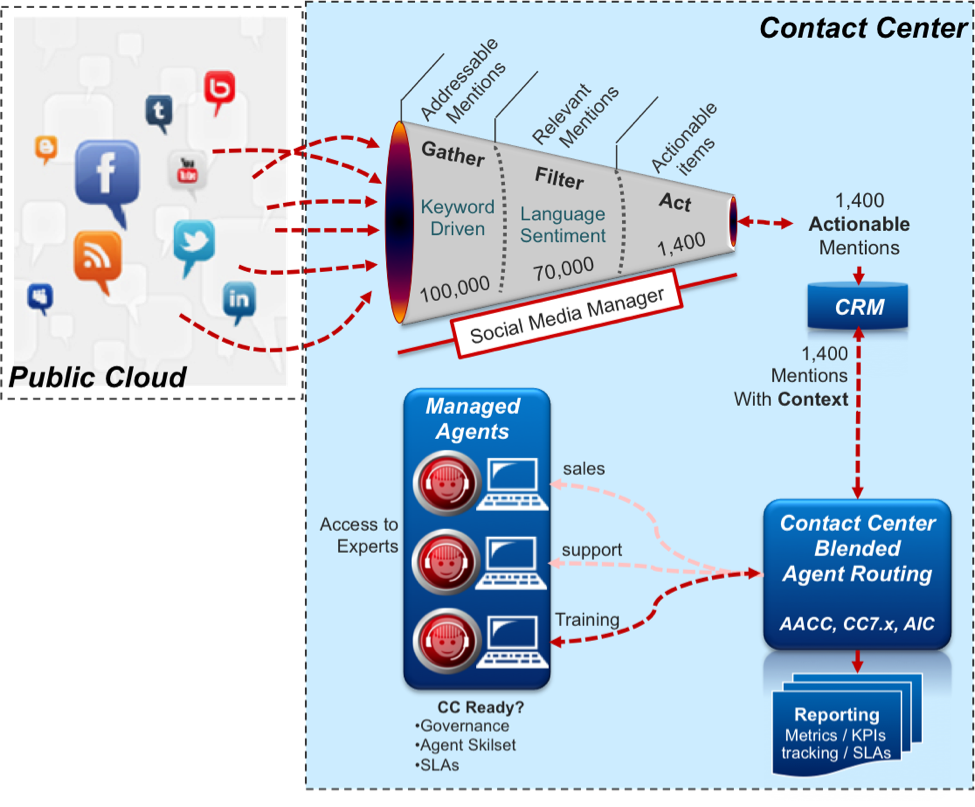
Having a tool that narrows down the actions from 100,000 to only 1,400 can clearly reduce the cost to monitor these channels. The tool can be expanded to integrate with an existing CRM database, linking actionable items to real customer information. This tool also provides real-time and historical reporting capabilities, allowing both the contact center and the Social Media Manager to know exactly what is going on and how to handle it.
7. Don’t be mistaken for a Robot
Users of social media are not just there to complain. They have joined these networks in order to socialize with other people. To help build relationships and loyalty for a company’s brand on social media, the online presence must be humanized as well. A call center agent who is used to running through a structured script will need to be trained to properly represent the brand. These individuals need to balance making the experience both an enjoyable experience for them and the customer, while also keeping within the branding guidelines. One company that does this well is HootSuite, a maker of social media tools. They tweet “shift changes” of who is responsible for their Twitter account. The individuals are encouraged to introduce themselves and have a little fun.

“If your customers have an emotional attachment to your products, make sure your social media agents have that same passion. Even in 140 characters, it shows” – Jeffrey Cohen (source).
8. Segregate your Presence
After a company’s social media presence is established and processes are in place and have been shown to work, some companies choose to create multiple Twitter handles and Facebook pages for different parts of the business if the social media load increases. Research shows that in 2012, 35% of brands use more than one Twitter account, up from 7% in 2011 (source). The most common split is to give customer support their own presence, allowing users the ability to self-segment the types of interactions they want to have with the company. Such segmentation may also occur if the company lacks proper social media coordination and a business function wants to operate independently.
9. Market your Customer Support
You should be communicating to your followers your new support offerings, not just responses to complaints. Expose your personality and your value. It is important for users to know where to turn if they have a problem, and it helps establish the brand as one that takes care of its customers. For example, if a customer tweets about how wonderful support is, retweeting that to the company’s followers not only markets your support, but also further strengthens the emotional bond between that customer and the brand.
10. Don’t Overcommit
The proactive use of social media by marketing departments has increased dramatically over the last decade. The danger is that its use may leave people too dependent on using technology tospeak, not allowing enough time to listen to customers. Social media is a key part of most companies’ strategy going forward, but it should not be the lynch pin.
So, what will the future bring? As available tools improve, further online channels can be monitored to provide brands with more information about what users are saying about them. For example, when a software developer runs into an apparent bug with Microsoft software, they do not typically call up Microsoft for support. Instead, they search for others who have reported the same symptom and hopefully there is a documented solution. These are often found in blogs and online forums. While one of those discussion boards may be Microsoft’s, there are countless other sites that contain that data. If Microsoft could crawl those sites, identify that a user found a potential bug, and then route that action to an employee to investigate and fix, they could improve their software quality. Consumer-focused products could take a similar approach with online retailers like Amazon, pulling product feedback either into the support team or to the marketing team for future action.
As social media technologies continue to grow in use and reach, companies must consider their integration and how they impact their brand(s). This is no longer the exclusive realm of the marketing department. Customer service teams must play an active role in monitoring the brand’s online presence. In order to get the most value and scale out of these activities, the effort should be integrated with CRM and contact center technologies, delivering the right contact, to the right employee with the right context. Solid execution of this approach will allow for quick and effective responses to negative brand impressions, not only allowing for image control, but also converting brand detractors into promoters.
Consumers as Global Citizens
Posted: August 4, 2013 Filed under: Uncategorized | Tags: consumer, documentary, globalisation, globalization, jamaica, life and debt, macroeconomics, review Leave a commentI watched the documentary, Life and Debt this morning. I can’t say I liked the tone used to tell this story. Clearly, the target audience was Americans, and yet the narrator intentionally insults her audience in the way the story is framed with regards to tourists. The insults distract from the point, making it hard to focus on the true message. As such, I feel my response is more confrontational and contradictory than I would have expected.
Local markets, especially for agriculture are a tough thing; even in the US, local producers face stiff (and some claim unfair) competition from imported goods. While there is no doubt that the government’s fiscal policies and interactions with other countries and world organizations are a huge factor in this, consumers have a responsibility as well (beyond just who they select as their government representatives). A century ago, Americans spent nearly half of their disposable income on food. As markets have opened up, food has become comparatively cheaper and American consumers now expect to pay far less. In fact, according to Gallup, Americans spend 25% less on food today (inflation-adjusted) than they did in 1944 (source). When this gets factored in with other changes, Americans now spend 13.3% on food (source). If consumers want to see a stronger market for domestic goods, they must choose to spend accordingly.
My wife and I intentionally pay a premium for local goods, especially meat and produce. For example, we pay ~$35 for a whole frozen chicken, several times over the price of chicken at the local supermarket. This takes more than just budgeting your finances to spend a greater % on food. It also means eating seasonally and/or canning. If you live in New England and want a strawberry in January, you can get one at the supermarket from Peru, from you freezer/can, or just go without. To put it another way, consumers must make the mental shift from thinking of food items as commodities (all onions are the same) and shift to think of a local onion as something entirely different than an imported onion.
I believe my American experiences conveyed above hold true to Life and Debt’s Jamaica. The documentary showed many Jamaicans lamenting the fact that people are consuming imported food. The Jamaicans have limited funds and when evaluating the value proposition of an onion, they are choosing the imported one as it appears to be more onion for less money. Consumers must learn to see the difference in the good itself as well as the value to the larger economy that can come of it.
However, in the global economy, not everything can be made locally in quantity. When the movie delved into the banana trade, they spoke about how it costs Jamaicans $11 to produce 40lbs of bananas while the South American countries can produce the same for $5. What to do? Why would a non-Jamaican consumer (or 3rd party buyer) pay more than twice as much for a banana? It seemed that Europe offered a good deal to the Jamaicans to purchase those bananas at such a price, but that can’t be expected to last indefinitely. In fact you could argue that the banana policy that is good for Jamaica is having a negative impact to the lives of banana plantation workers in South America.
Other markets (take the US for example) have lost the majority of entire industries to foreign competition, but the US has been more successful (not by luck, but by the policies the US itself puts into place globally) in upskilling the workforce to do replacement work. This is how we like to think of globalization rising the water for all boats. While that may be true in a nation like the US with a great deal of natural resources, influence, and existing capital, life is clearly much more difficult for countries like Jamaica who have little of those benefits.
This brings us to the organizations like the WTO and IMF, which are not much different than the predatory banking institutes we discussed in Inside Job. These groups were formed by the 1st world countries for their own benefit and that mission continues. I wouldn’t go so far as to say that these organizations set out to hurt 3rd world nations, but they do what’s in the best interest of 1st world nations, whether it hurts or helps the poor. Clearly the “free market”, left as is, will not come to the aid of the Jamaicas of the world, nor will they be able to pull themselves out of their poor economies by themselves with the global economy and policies as is. Changing this dynamic will require the nations in power to move from entirely self-motivated policies to something more magnanimous; seeing themselves as stewards of the world’s citizens, not just those of their own country; taking us back to the consumer citizen. The governments in control of the global economy (and thereby WTO, IMF, etc.) are representative of their citizens (some much more than others) and are charged with caring for the interests of their constituents. These citizens must demand, as a group, that their representatives change their mission to look after the larger good. I know this is no small feat, but I see it as the only way to bring change to the system.
How to do it? Getting the word out to the 1st world’s citizens is key. Documentaries, such as this one are a great way to do that, but Life and Debt missed this opportunity in two key ways. First, they did not connect the dots sufficiently for the audience on what they can do to bring change. Raising awareness with no funneled action isn’t beneficial. The other problem is that the film is overly confrontational with the very people it is trying to get help from. One could easily walk away from this film with the impression that Jamaica doesn’t really want American tourism business (although I’m sure they do). Hopefully, future documentaries of the same type will find a better balance of challenging the viewer to drive engagement, without alienating them all together. For a good example of this done well, see Black Gold.
More like black tin
Posted: August 4, 2013 Filed under: Uncategorized | Tags: black gold, coffee, economics, Ethiopia, GDP, global market, globalisation, globalization, ICA, International Coffee Agreement, macroeconomics, politics, price, Tadesse 1 CommentI recently watched a documentary entitled Black Gold, about the global coffee market and its impacts, specifically, on a group of farmers in Ethiopia as part of a macroeconomics class. Here are my thoughts in response.
I found this documentary quite interesting from a variety of aspects. To me, the theme is that economics (global or local) is about politics … and vice versa. Take Mr. Tadesse at the eight minute mark of the documentary speaking to the crowd of farmers he represents. He walks them through the economics of how the average price for a cup of coffee is $2.19 and that a kilo of coffee beans produces 80 cups of coffee, thus a kilo of coffee beans is valued at $230. Yes, these farms are only paid $0.23 per kilo, implying that there is a 1,000% profit that is being consumed by the “middle man”. This argument clearly lays out to the farmers why they need Tadesse representing them as the head of the co-op, trying to remove the middle-man and thus bring further profits to the farmer. This could easily be a speech by a politician to a corn farmer in Iowa. Of course what Tadesse is leaving out is that the value of a kilo of unroasted coffee beans on a farm in Ethiopia is very different than the value of a cup of coffee. The middle men to in fact add value and deserve some profit in the process. Someone needs to hand-pick (at $0.50 a day) out the bad ones, then transport them to a shipping port, move them across the world to another port, unload and transport to the roaster, roast the beans and repackage them, transport that to the retailers who grind them and heat and water to make coffee. Coffee that is put in a cup, in an air-conditioned building with tables, chairs, and Wi-Fi. That’s a great deal of additional value provided along the way and it is reasonable to expect those value providers to make a profit doing it. But that doesn’t rally the farmers and convince them to pay Tadesse’s salary and travel expenses.
Please don’t get me wrong, there’s a lot to be said for the farmers in this case. They clearly are not getting their fair share of the profit chain that they create. One can easily draw parallels to what is going on domestically with fast food workers and the minimum wage. Capitalism and the principles of economics teaches us how the invisible hand of the market will find the right wage and nobody can argue that even at the wages they make now (fast food workers and/or coffee growers) people are still willing to do the work, so the wage is balanced. Hopefully though, more and more consumers will realize that we are humans with a social contract with other humans and that paying people a living wage is in everyone’s best interest. We’ve read in our textbook how as wages go up, buying power increases, driving output which, if controlled properly, can grow overall GDP. The documentary makes this point towards the end by saying that if Africa’s share of world trade increased by 1% it would generate $70 billion, which is 5x the amount of aid the continent receives in aid. A compelling case, but it gets us back to politics. Every country tends to look out for the best interests of its own economy and it may end up being financially better for a country like the US to send aid to Africa instead of allowing them better terms in the global market. This is, of course, entirely different than what is morally right for the US to do.
It’s a complex game as coffee beans are grown by farmers in dozens of countries, all with different currencies, cost of livings, etc. Yet, they all get funneled into the same global market. For most consumers, a coffee bean is a coffee bean, regardless of its origin, hence a global price per kilo is reasonable. If these farmers from disparate countries were to unionize (for lack of a better term), they could then attempt to set a global price that would be much higher, by controlling production of coffee in each of the countries. This is clearly what the International Coffee Agreement was designed to do when it was originally signed in 1962. Of course at that time, the demand for coffee was shrinking and the post-WWII politics of capitalism vs. communism were in full swing, so an agreement was made to not only limit production of coffee but also limit demand in countries like the US, thus increasing the price. However, as with so many other things, the market changes and when demand not only rose over the next few decades, but then changed to prefer a milder bean (Arabica vs. Robusta) caused the types of beans in demand to change, which impacted coffee-growing nations differently depending on which varieties they exported. For example, Brazil, a large producer of mostly Robusta beans was not pleased with the shift to Arabica beans. This conflict causes the ICA to breakdown in 1989, leading to the average indicator price to plummet to ~$50.
The other issue that comes into play, as we learned in class, is the exchange rate. Even when the ICA was in place, you still had the issue of exchange rates. A global price of say $200 does not necessarily translate into the same standard of living for all coffee producers in all regions of all countries, unless all those nations pegged their currency to the dollar. Perhaps Tadesse was on to something: when the documentary was made, the global price was up to ~$110. In recent years, it spiked as high as over $300, but has since fallen back to $118 as of today. What I wasn’t able to determine was as those prices tripled did that mean the price paid to the farmer triple? Not necessarily.
I do feel better about my decision to buy “fair-trade” products whenever possible. In fact, at ~27 minutes into the documentary, we saw one of my favorite roasters in Tadesse’s cabinet, Dean’s Beans. I’ll be sure to continue to do what little I can to help improve the system for these global farmers.

Blame the financial referees, not just the players
Posted: July 10, 2013 Filed under: Uncategorized 1 CommentBlame attribution is something we all like to do when something goes wrong and the financial crisis covered in “Inside Job” is no different. Knowing what I did about the crisis from information sources such as NPR, I had assigned blame to the private financial institutions (AIG, Morgan Stanley, Countrywide, etc.) as they created this mess, they fed the beast, and then when the bubble popped, the leaders took their money and ran. The lack of apparent guilt and remorse just made me even more certain of the blame. However, after watching “Inside Job”, I think the US government is even guiltier than the private companies.
While I’m not one to give a “pass” to wrong doers (citizens or organizations), government’s job is to make the rules and enforce them in order to ensure things are fair. Imagine a soccer game where the referees didn’t show and the players self-regulated. I doubt anyone would be surprised if the rules were broken. Most athletes and the high-school level and beyond break the rules regularly, and just don’t get caught (“It’s only a foul if you get caught” mentality). If we take this soccer analogy further and say that there are enough goals for every player to continually score on goal with no risk of themselves being scored on, we might have the business climate leading up to this crisis: no referees, no rules, and no downside. Why? Because the referees weren’t there.
Private industry in the United States is incredibly productive and innovative due to the business freedoms that encourage and reward innovation and hard work. That often leads self-interested folks to say that no regulation is needed and that the free market will self-correct (Adam Smith’s invisible hand). That may be the case in a TRUE free market, but that is not reality either. When governmental rules are put in place to regulate the market, but it is the industry titans themselves that set those rules, we get into oligopolistic scenarios, the antithesis of a free market. An independent (or “balanced” at a minimum) government is needed in order to put rules in place to protect its citizens, national economy, and the global economy as a whole. Short-term wins need to be balanced against long-term risks. In fact, corporations owe a debt to the nation as a whole for the security and infrastructure it provides for those companies to operate profitably. Perhaps nobody has explained this “social contract” concept as well as Senator Elizabeth Warren when campaigning in 2011 (link)
As covered in the documentary, this lack of regulation began decades previously with the Regan administration attempting to boost the economy by removing regulation. With this school of thought continuing (through a particular school of thought made popular in industry and academia) through all subsequent US administrations, the regulation was loosened and loosened. Even when the government became aware of what now seems all the warning signs (CDOs, leverage ratios, etc.), they didn’t turn a blind eye, they actually endorsed this behavior.
Does this lack of regulation by the government provide a free pass to the corporations? Absolutely not. These financial leaders, men and women with years of experience and the intelligence to build such complex financial offerings, should have been more responsible. They knowingly focused on short-term revenue and ignored the inherent risks to their corporations and to the global economy. They had the smarts to foresee this crisis and the responsibility to prevent it. However, there are so many players in any market and they are, by definition, motivated by profit. We don’t expect our professional athletes to self-sacrifice a championship (and their related compensation) just because it would be for the betterment of their conference. Instead, rules are setup ahead of time to guide and motivate the teams in other ways to accomplish what is best for all. Likewise, it is the government’s responsibility to regulate markets in a fair and balanced way so as to respect the social contract, ensure fair and level playing grounds, and look out for the long-term interests of its people. Those were all violated in the case of this recent financial crisis and thus the government has the lion’s share of the blame.
Dust Off That Treadmill in the Basement and Burn Off Those Pounds While at Work
Posted: June 6, 2013 Filed under: Uncategorized | Tags: ADVD, cancer, desk, health, sitting, smoking, standing, treadmill desk, walking, weight loss, work life balance, work-at-home 1 CommentHow and why I upgraded to a treadmill desk, creating a much healthier work/life balance, losing weight, all the while not adding any time to my day for exercise. This post was originally on Avaya’s site as well as B2C.
After years of back problems resulting in physical therapy, I knew I needed to make a change. The biggest problem for me was the 11 hours a day I spend at my desk, hunched over my keyboard. While I know that good posture could help out a lot, the truth is that as I get in to “the zone”, I stop paying attention to posture and the next thing I know, my body is aching.

The plight of strain caused by sitting at a desk is unfortunately not unique to me. Harvard Business Review did a great article on how Sitting Is the Smoking of Our Generation. I don’t think the title is an embellishment; like smoking, sitting at your desk is a bad health choice people willingly make every day. CBS News ran a story on how your desk job is making you fat.
After some thought, I decided to haul our unused and dusty treadmill out of the basement up to my second floor (did I mention my back isn’t doing great?) home office. With my wife’s woodworking skills we built some functional (not attractive) tables of the appropriate height out of 4x4s for the posts and plywood for the tabletop.

We then placed the existing tables on top of these new tables, effectively raising my desktop to be about 5 feet off the ground. This allowed me to place my phone (an Avaya Desktop Video Device on the left), three monitors, and my MacBook Pro at a healthy viewing height, with proper spacing and positioning (verified by OSHA’s website). To make the keyboard and mouse accessible, we built a wood shelf from a 2×8 board long enough to not only go across the handlebars, but also extend further to give me more counter space. This was the trickiest part as my handlebars are slanted, requiring some more creative building to get a shelf mostly level. Below is what that setup looks like.


The results have been great. In the first five months, I averaged six miles a day, with my all-time best being 11 miles in a single day. I typically walk at a pace of 2.0 mph, which is about as fast as I can comfortably go while still being able to type, work, and if on the phone, talk. When on a conference call that I need to speak on, I will reduce the speed to 1.5mph as my treadmill wasn’t really meant for this use and thus is a little loud in the background. I’m also doing more and more video conferencing which adds an interesting wrinkle as I look a little odd to others on the conference. Depending on the situation, I may pause the treadmill until the video call is over.
No, Google is not Making us Stupid
Posted: June 3, 2013 Filed under: Uncategorized 5 Comments I finally read Nicholas Carr’s “Is Google Making Us Stupid?” in The Atlantic this week at the prompting of my summer professor, Shari Worthington. I applaud Mr. Carr’s relatively balanced take on the topic. While reading the first half I found myself making several notes, only to find Nicholas make the same counter arguments in the second half of the article. However, I believe his lingering fear over the Internet’s impact to the way we think is unfounded. For example, he says that
The Internet is a machine designed for the efficient and automated collection, transmission, and manipulation of information, and its legions of programmers are intent on finding the ‘one best method’—the perfect algorithm—to carry out every mental movement of what we’ve come to describe as “knowledge work.”
As those of us more familiar with the workings and “design” of the Internet can attest, this is simply not the case. Sure, programmers, like anyone practicing a science are always interested in perfection, but the architecture of the Internet is really more like rules to make sure the variety of technologies, designs, and people don’t step on one another. There is no grand conspiracy on how information is organized and presented to the masses. Instead, like nature, lots of attempts are put forth and natural selection determines the ones that survive until the next challenge. Sure, Google wants you to trust its organization of what is out there, but there is nothing stopping from you using other services.
Mr. Carr speaks to how he and his friends are noticing a change in how they read books. While I wouldn’t attempt to argue that as we have more and more information available to us it becomes harder to focus on any one source (my wife and I both watch TV at night with laptops in our laps), Carr makes too large a leap by saying that this is due to the Internet causing a rewiring in our brains. I find it more likely that other factors such as age, ambient light, or a smartphone buzzing in your pocket are more likely at fault. I know that when I got on an airplane and pull out a book, I get completely immersed in my reading, but if I try to do 30 minutes of reading in the living room with kids running around, I can’t get past the second page. There is also research that suggests one’s attention span declines with age.
My favorite part of the article was when Carr brings in the legendary Frederic Taylor’s time/motion studies during the industrial revolution as a lens to use to look at the information revolution. A great approach, but Mr. Carr and I see different things through that looking glass. While Taylor was attempting to optimize manual labor in order to drive costs down and increased productivity and profits, Carr misses that Google isn’t getting profitable by rearranging how I make breakfast in the morning. The order I make my eggs and toast is irrelevant to them. Instead, Google is pioneering methods to know which eggs and bread I used and more importantly what I’m reading while I consume them in order to put the most relevant advertising in front of me. Taylor was about maximizing profit through work optimization. Google is after profit through data gathering. The Taylor lens simply blurs this phenomenon instead of bringing it into focus.
This blurring effect seems to bleed into Mr. Carr’s analysis of Google’s Sergey Brin whom he quotes saying
Certainly if you had all the world’s information directly attached to your brain, or an artificial brain that was smarter than your brain, you’d be better off.” Carr interprets this as “idea that our minds should operate as high-speed data-processing machines.
Actually, Brin is conveying that if we had all that information easily accessible like that, it would maximize the productivity of one’s intelligence. And therein lies the true comparison to Taylor and the Industrial Revolution. Like factories of the time that benefited from plugging into the new electrical grid to power their productivity, the Internet fuels the new knowledge economy. Google, as the face of the Internet, is not looking to grow profit by changing the way you think. Instead, they charge a utilization fee (in the form of advertising) for plugging into their grid of knowledge.
To take this analogy one step further, while all factories with electricity were not successful, all humans with access to the Internet will not gain wisdom and new ideas. Innovation comes from pulling together new ideas from existing information. Imagine if Albert Einstein’s brain had immediate access to all of the world’s data: What other connections/discoveries could he have identified?
Carr actually touches on this point when referencing Richard Foreman‘s fear that we “risk turning into ‘pancake people’—spread wide and thin as we connect with that vast network of information accessed by the mere touch of a button.” I think Mr. Foreman is close, yet misses the mark. Yes, our new ready access to information has definitely allowed us to spread wide, and by definition somewhat thinner. And while discovery can come from going deeper in the narrow stovepipe of just one area, it can also come from going wide and seeing multi-disciplinary connections that others have never seen before. This is where our new information age offers the most opportunity for innovation and wisdom.
Bernard of Chartres (a 12th century philosopher) once said that
“We are like dwarfs on the shoulders of giants, so that we can see more than they, and things at a greater distance, not by virtue of any sharpness of sight on our part, or any physical distinction, but because we are carried high and raised up by their giant size.” (source)
Likewise, Google and the larger Internet allow us to see further than those before us. If that makes us dwarves in Carr’s eyes, so be it.
The Office
Posted: May 20, 2013 Filed under: Uncategorized Leave a commentJust finished watching the final episode of The Office. A great ending to a great show. I feel like a much less funny version of the character Jim. He worked at Dunder Mifflin for 12 years. My 12th service anniversary at Avaya is this coming Tuesday. He met the love of his life, Pam, at the office. I did the same with my wife. I’m now enjoying thinking about what watching myself over the last 9 years would be like: I think it would be weird, but satisfying.
Jayne Gorman and British Airways
Posted: December 10, 2012 Filed under: Uncategorized | Tags: best practices, booking, british airways, customer support, jayne gorman, satisfaction, social media, Twitter Leave a commentLike my previous post, I thought I’d share with others what I built.
In late October, Jayne Gorman (@janetravels) reached out to British Airways (@British_Airways) on Twitter for help and was less than pleased with her experience. She wrote an article about this experience here. Below are the tweets I could find on the topic. You’ll note that BA apparently deleted its tweets on the topic as I could not find them anywhere.
- https://twitter.com/jayneytravels/status/261553711690702848
- https://twitter.com/jayneytravels/status/261551729143840768
- https://twitter.com/jayneytravels/status/261555659361902592
- https://twitter.com/jayneytravels/status/261555867235782656
- https://twitter.com/jayneytravels/status/261558273939996672
- https://twitter.com/jayneytravels/status/261558396757630977
- https://twitter.com/jayneytravels/status/261560111372308481
- https://twitter.com/jayneytravels/status/261808218441920512
- https://twitter.com/jayneytravels/status/261828383762153473
- https://twitter.com/jayneytravels/status/262284986001014785


Kevin Smith and Southwest Airlines
Posted: December 10, 2012 Filed under: Uncategorized | Tags: Air Travel, complaint, Customer Service, Kevin Smith, social media, Southwest, Southwest Airlines, Twitter Leave a commentI’m in the last days of a paper I’m writing for my marketing class. The topic is on branding, social media, and customer service. I decided to include an example from Kevin Smith and Southwest Airlines. The articles I found on the topic are:
- http://mashable.com/2010/02/14/southwest-kevin-smith/
- http://www.huffingtonpost.com/2010/02/14/director-kevin-smith-too_n_461803.html
- http://articles.latimes.com/2010/feb/16/entertainment/la-et-kevin-smith16-2010feb1
As part of what I wrote, I wanted to reference all 19 tweets on the topic that I could find, so I spent over an hour taking screenshots and Photshop’ing them together. As such, I thought I’d share the images here as well as the URLs they came from.
- https://twitter.com/ThatKevinSmith/status/9079110598
- https://twitter.com/ThatKevinSmith/status/9079178737
- https://twitter.com/ThatKevinSmith/status/9079364627
- https://twitter.com/SouthwestAir/status/9079668884
- https://twitter.com/SouthwestAir/status/9080131812
- https://twitter.com/ThatKevinSmith/status/9080810468
- https://twitter.com/ThatKevinSmith/status/9081211151
- https://twitpic.com/1340gw
- https://twitter.com/ThatKevinSmith/status/9081464709
- https://twitter.com/SouthwestAir/status/9082897934
- https://twitter.com/SouthwestAir/status/9084272759
- https://twitter.com/ThatKevinSmith/status/9088969528
- https://twitter.com/SouthwestAir/status/9089048580
- https://twitter.com/SouthwestAir/status/9089068708
- https://twitter.com/SouthwestAir/status/9105497213
- https://twitter.com/SouthwestAir/status/9110527847
- https://twitter.com/ThatKevinSmith/status/9110690242
- https://twitter.com/ThatKevinSmith/status/9128066586
- https://twitter.com/ThatKevinSmith/status/9166100231
- https://twitter.com/ThatKevinSmith/status/9211873461



 Carl Knerr